
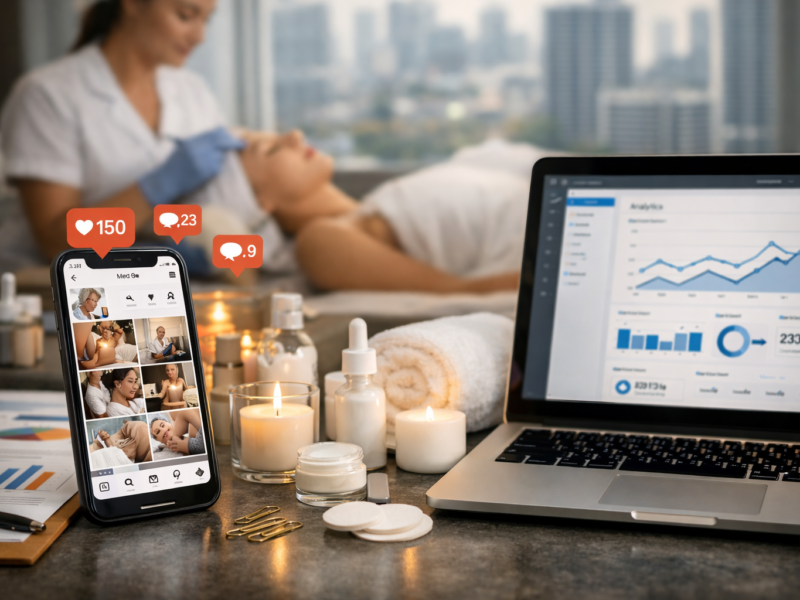
In today’s digital landscape, the impact of social media on brand visibility is undeniable, and Instagram stands at the forefront as a powerful engine for engaging audiences. Med spas, with their visually appealing results and transformative services, can use Instagram’s platform to build client relationships and widen their reach. Instagram’s scale is also larger than most owners assume. Industry tracking sites report Instagram reached about 3 billion active users in Q3 2025, which means your future clients are already there, even in smaller cities and suburbs. 
This playbook walks you through fine-tuning your Instagram setup, avoiding common pitfalls, and building a measurement plan that uses real numbers, not vague “it feels like it’s working” signals. You will also see how to connect Instagram activity to consult requests and bookings, because that is what makes your reporting credible and useful.
One more reason this matters in 2026 is market pressure. The global medical spa market was estimated around USD 21.21 billion in 2024 and is projected to reach USD 78.23 billion by 2033, with a mid-teens CAGR. More growth means more clinics, more ads, and more competition for attention. 
Section 1: Instagram Setup and Basics
A strong foundation is the first step toward Instagram success for your med spa. This section is about two things. Conversion and measurement. Conversion means your profile turns visitors into calls, DMs, and booked consultations. Measurement means your tracking is consistent, so you can trust the numbers you report.
Create a business account, then connect what you need to measure outcomes
Converting to a professional business account is essential because it unlocks Insights and contact actions. Without Insights, you will be guessing. With Insights, you can see reach, impressions, profile visits, and content interactions at the post level and over time.
Do not stop at switching account type. Set up the measurement layer immediately, while your account is clean.
Start with Google Analytics and UTM tracking. Google’s own guidance is simple. If you add UTM parameters to links you share, Analytics can show which campaigns sent traffic, and those parameters appear in the Traffic acquisition report. 
A practical UTM naming standard for med spas keeps reporting clean:
- Use utm_source=instagram on every Instagram link.
- Use utm_medium=social for organic posts and Stories, and utm_medium=paid_social for ads.
- Use utm_campaign for the offer or initiative, like 2026q2_tox_consults or 2026q2_laser_leads.
- Use utm_content to distinguish creative, like reel_hook1 or story_testimonial3.
If you do not standardize this, your reports will split into messy duplicates, and you will not be able to compare month to month.
Optimize your profile like a landing page
Think of your profile as a high-intent landing page, because most people who reach it are validating you. They may have found you through a Reel, a friend’s share, a Google search, or your reviews. Many will decide in seconds whether you feel safe, professional, and worth the consult.
- Profile photo: Use a clear logo or a clean brand mark. It should read well on a phone.
- Name field: Add searchable service terms plus location where it fits, because this field influences discovery inside Instagram search.
- Bio: Answer four questions fast. What you do, where you are, who you help, and what to do next.
- Contact buttons: Ensure call, email, and directions are active and correct.
- Link in bio: Keep it focused. One primary action first, usually “Book a consultation,” then supporting links.
If you use a link hub, keep it short and measurable. Make your first button the booking link, not a menu of choices. Every extra click lowers conversion.
Build Highlights that remove fear and shorten decision time
Most med spa purchases are not impulse buys. People want reassurance. They want to understand pain, downtime, safety, and whether results look natural.
Use Highlights as your permanent trust library. A simple set that works across most clinics includes:
- Results and before-after context, with patient consent and clear timelines.
- Treatments explained, who is a fit, who is not, how many sessions, what it costs in ranges.
- Aftercare and what to expect day-by-day.
- Meet the team, credentials, hygiene, and safety practices.
- Reviews and common questions.
Your Highlights also protect your front desk. The more you answer upfront, the fewer repetitive DMs you need to handle, and the more time your team has for high-intent leads.
Set clear content rules for patient privacy and endorsements
Med spas live in a trust-sensitive category. If your content includes patient images, videos, or identifiable treatment context, you must treat consent as non-negotiable. The HIPAA Privacy Rule protects individually identifiable health information held or transmitted by covered entities and their business associates, and it defines that information as protected health information. Even when HIPAA coverage is nuanced in aesthetics contexts, written authorization and clear policy are still the safest operating standard for maintaining trust and reducing risk. 
If you use influencers or do any compensated partnerships, disclosures must be obvious. The FTC guidance states that if there is a material connection, it should be clearly and conspicuously disclosed unless it is already clear from context. 
This is not a small detail. A single poorly disclosed post can damage credibility and trigger platform issues, especially when medical claims or sensitive outcomes are involved.
Section 2: Common Mistakes to Avoid
Most Instagram “failure” in med spas is measurement failure. Teams post, see likes, and assume progress, while bookings stay flat. The fixes are usually simple, but they require discipline.
Ignoring Insights, or looking at Insights without asking the right questions
Checking Insights is not enough. You need a recurring rhythm and specific questions.
Weekly, you should know what content drove saves and shares, because those are strong intent signals in aesthetics. You should know what drove profile visits, because that indicates curiosity and validation behavior. You should also track what drove link clicks and DMs, because those are the closest Instagram gets to a lead event without ads.
Monthly, you should know what drove consult requests and booked consults, because that is what owners care about.
Posting too much or too little, without considering your lead handling capacity
Many clinics focus on output, not response. Instagram is a conversation channel. If you post daily but reply slowly, you create demand you fail to convert. If you post rarely, you lose momentum and mindshare.
A useful benchmark is to align frequency to your operational capacity. If you can reliably post three times a week, reply fast, and follow up, that often beats seven posts a week with slow response.
Industry benchmarks also show frequency and engagement are not linear. Hootsuite’s benchmarking work in healthcare suggests the highest engagement rate in that dataset occurred around two posts per week, not maximum volume. Use this as a reminder to test, not to copy blindly. 
Using engagement rate without defining the formula
This is one of the biggest reporting errors in med spa social. Some teams calculate engagement as engagements divided by followers, others use reach, others use impressions. The numbers can look wildly different for the same post.
Pick one definition and do not change it mid-quarter.
A clean option for med spas is engagement rate by impressions, because it accounts for distribution. Another is engagement rate by reach. Choose one, document it, and apply it consistently across posts and months.
If you want a benchmark, Hootsuite reported average Instagram engagement in healthcare around 3.7% and average Reels engagement around 2.7% for Q4 2024 and Q1 2025 in their analysis. Use this for directional comparison, then focus on your own trendline as the real goal. 
Over-focusing on hashtags while ignoring conversion paths
Hashtags can help categorize and lightly assist discovery, but they are not a strategy. Your strategy is content that earns saves and shares, a profile that converts, and a follow-up system that books.
Use a small set of relevant tags, keep them consistent, and stop spending hours on it. Put that time into better creative and better response time.
Not connecting Instagram to your review layer
Med spa decisions are rarely based on one post. People validate. Reviews sit at the center of that validation loop.
BrightLocal’s 2026 survey reports 97% of consumers read reviews online, and 41% say they always read reviews when browsing for businesses. That is the decision layer you must support if Instagram is driving attention. 
If your Instagram is doing its job, more people will check your Google Business Profile and your review profiles. If your reviews are weak, your funnel leaks.
Treating “more followers” as the goal instead of more booked consultations
Follower growth helps, but follower growth alone is not success. You can grow followers and still lose money if your audience is not local, not qualified, or not ready to buy.
Your real hierarchy should be consult requests, booked consults, show rate, and revenue. Everything else is supporting.
Section 3: Simple Measurement Plan
A measurement plan should make decisions easier, remove arguments inside your team, and prove ROI in a way a non-marketer understands.
Set clear goals tied to the consult funnel
SMART goals are a good start, but med spas need goals that connect to outcomes.
A simple funnel to measure from Instagram looks like this:
- Exposure: reach, impressions, video views.
- Interest: saves, shares, profile visits.
- Intent: link clicks, call clicks, direction taps, DMs started.
- Conversion: consult request submitted, consult booked.
- Revenue: show rate, close rate, average revenue per booked consult.
Now set targets on the conversion steps, not only on vanity steps.
A realistic quarterly goal set might look like this:
- Increase consult requests attributed to Instagram by 20%.
- Increase booked consults from Instagram DMs by 25%.
- Improve show rate by 10 percentage points through better pre-consult messaging and reminders.
- Increase bookings per 1,000 profile visits by 15%.
This is the difference between “Instagram is doing well” and “Instagram is driving growth.”
Track the KPIs that matter, then standardize definitions
Do not track 40 metrics. Track a tight set that maps to your funnel.
For most med spas, a strong core set is:
- Reach and impressions per week.
- Saves per 1,000 impressions.
- Shares per 1,000 impressions.
- Profile visits per 1,000 impressions.
- Link clicks and click-through rate on Stories.
- DM starts and DM-to-consult conversion rate.
- Consult requests attributed to Instagram.
- Booked consults attributed to Instagram.
- Show rate and consult-to-treatment close rate.
Standardize definitions and stick to them for at least 90 days. If you change definitions, your trendline becomes meaningless.
Implement attribution that survives real-world behavior
Instagram attribution breaks because people do not move in a straight line. They watch a Reel, then later Google you. They DM, then call. They save a post, then book two weeks later.
You will never get perfect attribution, but you can get reliable attribution.
Start with UTMs on every link you control. Google’s URL builder documentation explains how adding UTM parameters lets you identify campaigns that refer traffic, and those values appear directly in acquisition reporting. 
Then add two capture points that catch “dark” conversions.
- First, a consult intake form question: “How did you hear about us?” with Instagram as an option.
- Second, a DM workflow that always sends a trackable booking link, so you can connect DM conversations to site sessions and conversions.
This also makes your front desk more effective. A structured DM process increases the odds a curious person becomes a booked consult.
Monthly reporting that owners trust
A monthly report should tell a clear story. What you did, what changed, what it meant, and what you will do next.
A simple structure works:
- What we published this month, by theme and format.
- What happened in top-of-funnel distribution, reach and impressions trend.
- What happened in intent signals, saves, shares, profile visits, link clicks, DMs.
- What happened in outcomes, consult requests, booked consults, show rate, revenue tied to those consults.
- What we will test next month, two creative tests and one conversion test.
Use benchmarks for context, but keep your own baseline as the main scoreboard. In healthcare, Hootsuite’s reported average Instagram engagement around 3.7% and Reels around 2.7% gives you a reference point, but your month-over-month improvement matters more than beating an industry average. 
Case patterns and real numbers you can use as a reality check
Med spa outcomes vary by offer, market, and execution, but it helps to see what “real numbers” can look like when campaigns are run with a clear lead path.
Some published agency case studies report results like 37 leads in one month on USD 426.71 spend, with a reported cost per lead of about USD 7 for a local aesthetics clinic campaign. Treat these as directional examples, not guarantees, because they are not audited and they depend heavily on targeting, creative, and sales follow-up. 
The reason these examples matter is not the exact cost per lead. It is the structure. Clear offer, clear lead capture, fast follow-up, and tracking that connects spend and creative to consults.
Conclusion: Maximizing Your Instagram for Med Spa Success
Instagram metrics only matter if they change business outcomes. Your setup creates the conditions for conversion and accurate reporting. Avoiding common mistakes keeps your team from chasing noise. A measurement plan ties content to consult requests, bookings, and revenue so you can make decisions with confidence.
In 2026, patients increasingly use digital signals to choose providers. One survey report found 35% of patients have chosen a provider based on social media presence, which reinforces why your Instagram presence and measurement system deserve serious attention. 
Your next step is to apply this playbook for 30 days without changing definitions. Set your baseline, track weekly, report monthly, and make only a few targeted improvements at a time. That is how you build a channel you can scale and defend with real numbers.
Discover more from The Digital Cauldron
Subscribe to get the latest posts sent to your email.