
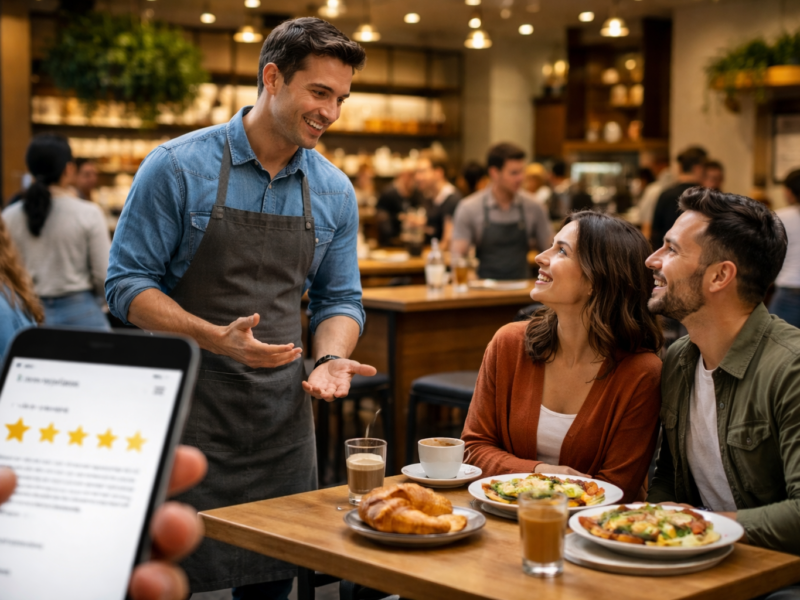
A 1-star review feels personal because, for a café or restaurant, it often is. Guests are not reviewing a piece of software. They are judging a meal, a mood, a wait time, a greeting, a table touch, a manager decision, and the feeling they carried out the door. In 2026, that judgment travels fast. BrightLocal’s 2026 research found that 97% of consumers read reviews when researching local businesses, and Toast’s 2025 restaurant survey found that 94% of respondents say online reviews influence where they choose to eat. On top of that, 46% of diners say Google Reviews is the first place they check for restaurant ratings, which means a single poor review can shape demand before a guest ever sees your menu. 
That is the bad news. The good news is that review damage is often recoverable, especially when the business moves fast, sounds human, fixes the actual failure, and closes the loop with discipline. BrightLocal’s 2026 data shows that 89% of consumers expect owners to respond to reviews, 19% expect a same-day response, 32% want one by the next day, and 81% expect a response within a week. The same research also shows that 80% of consumers are more likely to use a business that responds to every review, while 42% are unlikely to use one that ignores reviews altogether. In other words, your reply is not just for the unhappy guest. It is for every future guest reading that thread. 
This is where a 7-day recovery sprint works. It gives you a short window to contain public damage, reopen contact, offer a fair make-good, brief the team, show visible improvement, track the result, and ask for a second chance without sounding desperate. It also keeps you inside platform and legal rules. Google says replies should be professional, short, relevant, and conversational, not promotional. Google also prohibits offering incentives in exchange for customers posting reviews, changing reviews, or removing negative reviews. The FTC’s Consumer Reviews and Testimonials Rule, which took effect on October 21, 2024, also targets fake or deceptive review practices. So the goal is not to buy a better reputation. The goal is to earn one. 
Day 1: Respond fast, with empathy, and without excuses
The first day is about public triage. Your reply should do four things well. It should acknowledge the issue, show regret, signal ownership, and move the detailed conversation off the public thread. It should not argue, guess, blame a rush, call out the guest, or paste a canned script that could fit any complaint. That last point matters more than many operators realize. BrightLocal found that 50% of consumers are unlikely to choose a business if responses feel generic or templated. 
A strong public response sounds like this:
“Hi Sarah, I’m sorry we missed the mark on your visit, especially on the wait time and the food temperature. That is not the experience we want anyone to have. I’d like to look into this properly and make it right. Please contact me at manager@yourcafe.com or call us at 604-555-1234 and ask for Imran.”
That works because it is short, specific, and human. It mirrors Google’s own guidance, which says replies should be clear, helpful, short, relevant, and conversational. It also shows future readers that you took the complaint seriously enough to mention the real issue, not just “your feedback.” 
If the review contains abuse, hate speech, impersonation, or something that clearly breaches platform rules, flag it. But do not treat flagging as your main plan. Google allows businesses to report reviews that violate content policies, yet many poor reviews stay live because they describe a genuine experience, even if the guest is angry or unfair. The practical move is to respond as if the review will remain public. 
Day 2 and Day 3: Build a make-good that matches the failure
A weak recovery offer often fails for one reason. It does not fit the harm. A cold coffee and a delayed croissant do not need the same answer as a birthday dinner ruined by a missing reservation, an undercooked entrée, or a rude staff exchange. Cornell research on restaurant complaint handling shows that guests’ satisfaction with complaint outcomes is positively linked with their intention to return. Earlier Cornell work also notes that more serious failures call for higher-effort recovery, such as manager intervention, discounts, coupons, or replacement items, rather than a simple apology alone. 
That means your make-good should be proportional. If the issue was minor, offer a focused second chance, such as dessert for two, a replacement drink, or priority seating on the next visit. If the issue was a full meal failure, offer a hosted return visit tied to the same daypart so you can prove the experience has changed. If the issue involved service disrespect, the recovery should include a manager-led welcome and assurance that the concern was addressed internally. The point is not to hand out free food blindly. The point is to remove the guest’s risk in giving you another shot.
Be careful with the wording. Do not say, “We’ll give you a free dessert if you update your review.” Google explicitly says incentives in exchange for posting, changing, or removing reviews are prohibited. Instead, say, “We’d like the chance to host you again and make this right.” That keeps the offer tied to service recovery, not review manipulation. 
A good example is a brunch café that gets a 1-star review for a missed allergy note and a long remake time. The right response is not a generic 10% coupon. It is a direct call from the manager, a note on the guest profile, a hosted remake visit, and a kitchen briefing before the guest returns. That is more work, but restaurant service recovery research has been clear for years. When the guest feels the outcome was handled well, return intent rises. 
Day 4: Brief the team and fix the root cause
A public reply without an internal fix is a delay tactic, not recovery. By Day 4, the manager should know exactly what went wrong. Was it ticket time? Expo breakdown? A host stand issue? Shift change confusion? Incorrect item coding in the POS? A staff attitude problem? A cleanliness miss? Toast’s 2025 restaurant feedback survey found that exceptional service and food are the top reasons guests leave reviews, at 39% and 33% respectively. That tells you where the recovery work should start: service behavior and food execution. 
The staff briefing should be short and specific. Review the complaint facts, not the guest’s personality. Confirm the recovery promise. Re-state the standard for greeting, timing, remake handling, table checks, and escalation. Decide who owns the guest if they return. This is also where many operators make the biggest mistake. They treat review recovery as a marketing issue when it is really an operations issue first.
You do not need a long meeting. You need a clean reset. For example, if the review mentions being ignored after a bad dish was served, train the floor team on one rule: any complaint about food quality gets acknowledged at table within one minute and manager touch within five. If the review mentions order errors on takeout, add a second bag check and receipt callout before handoff. These small fixes matter because diners are highly sensitive to rating drops. Toast data shows that 43% of people will not consider a restaurant if its rating falls below roughly 3 to 3.5 stars. 
Day 5: Use TikTok and social proof to rebuild confidence in public
You do not answer a bad review with a glossy ad. You answer it by making your improvement visible. In 2026, that means social content has a real role in reputation repair. Sprout Social reports that nearly a quarter of people now turn to social first for answers, and almost half of Gen Z begins brand or product searches on platforms like TikTok or Instagram. Restaurant discovery is part of that shift. BentoBox survey results reported by Restaurant Dive found that 43% of Gen Z uses TikTok for restaurant discovery, while 54% of Gen Z uses Instagram for that purpose. 
For a café or restaurant, Day 5 content should not say, “We got a bad review and fixed it.” That sounds defensive. Instead, show the work. Post a short video of the pass during peak service with clean plating and ticket timing. Show a manager doing pre-shift. Show how allergy notes are marked. Show a barista remaking a drink because “close enough” is not good enough. Show a real guest reaction to a popular item. Show staff warmth, pace, and consistency. This kind of content helps future diners see proof of standards, not claims.
There is also a simple psychological reason this works. A review is static. Video is living evidence. If someone sees a harsh review and then sees fresh, believable content of a busy, well-run service, the brand looks active and accountable, not absent. That matters even more now because review recency and response recency are both rising in importance for consumers. BrightLocal’s 2026 survey found that many consumers now want very recent reviews, with 32% looking for reviews written in the last two weeks. 
Day 6: Track the sprint like an operator, not just an owner
Recovery fails when nobody measures it. By Day 6, you should know whether the guest replied, whether the offer was accepted, whether a revisit happened, whether new positive reviews appeared, and whether the same complaint pattern is still showing up. Toast reports that 84% of people leave restaurant feedback at least occasionally, and over half are likely to leave feedback when asked, especially when prompted in the right context. That means your guest sentiment is not hidden. It is measurable if you bother to collect it. 
Keep the tracking simple. Log the date of the review, the issue type, channel, response time, manager assigned, guest contacted or not, recovery offer made, offer accepted, revisit date, and outcome. Then add one useful field: root cause. If you keep seeing “slow service on lunch,” “cold fries on delivery,” or “host stand confusion on weekends,” you do not have isolated review problems. You have a pattern.
The restaurant groups getting this right are not guessing. Ascent Hospitality Management, which oversees Perkins and Huddle House, increased review response rates from 18% to 99%, a 450% jump, after improving how reviews were handled across 556 locations. Tortilla in the UK reported a 262% increase in review volume and improved its overall star rating from 4.3 to 4.7 after taking a more disciplined approach to reviews, surveys, and listings. Those are chain examples, but the lesson applies to a single-site café just as much. What gets tracked gets fixed faster. 
Day 7: Follow up directly and ask for a second chance, not a favor
By the final day, the sprint needs closure. If the guest has not replied, send one final, polite message and stop. If they did reply and accepted the make-good, confirm the plan, assign a manager owner, and prepare the team. If they already came back, follow up within 24 hours. Thank them for giving you another chance. Ask one clear question: “Did we make this right?” If the answer is yes, you can invite them to share updated feedback, but never pressure them and never trade anything for it. Google’s policy is clear on that point. 
This follow-up matters because good service recovery does more than calm a complaint. Qualtrics notes that when an issue is resolved well, customers can become more loyal over time than those who never had a problem at all. Cornell’s restaurant research points in the same direction, linking satisfaction with complaint outcomes to stronger repeat patronage intent. That is why the goal of the sprint is not “remove the bad review.” The goal is “earn the return visit.” The changed review, if it comes, is just the visible result. 
What a strong 7-day sprint looks like in practice
Picture a neighborhood café that gets a 1-star Google review on Sunday night. The guest says the cappuccino was lukewarm, the avocado toast arrived late, and staff acted indifferent when the problem was raised. On Monday morning, the owner replies publicly, names the issues, apologizes, and shares a direct contact. By Tuesday, the guest has spoken with the manager and is offered a hosted return breakfast, with a manager greeting on arrival. On Wednesday, the kitchen lead and front-of-house team review ticket flow and remake handling. On Thursday, the café posts a short behind-the-scenes clip showing the breakfast line, quality checks, and the morning briefing. On Friday, the manager tracks the case and notices two similar complaints from the same rush period, pointing to a staffing issue, not a one-off incident. On Saturday, the guest returns, is looked after properly, and leaves satisfied. On Sunday, the manager follows up. That is review recovery. It is not magic. It is pace, ownership, and follow-through.
In 2026, the businesses that win are not the ones with no criticism. They are the ones that respond like adults, fix what failed, and show enough consistency that a bad moment does not define the brand. Reviews now shape traffic, trust, and conversion at the exact point people decide where to eat. If you handle a 1-star review with speed, empathy, and real operational change, you do more than contain damage. You show every future guest that your business listens, learns, and deserves another try. 
Discover more from The Digital Cauldron
Subscribe to get the latest posts sent to your email.