
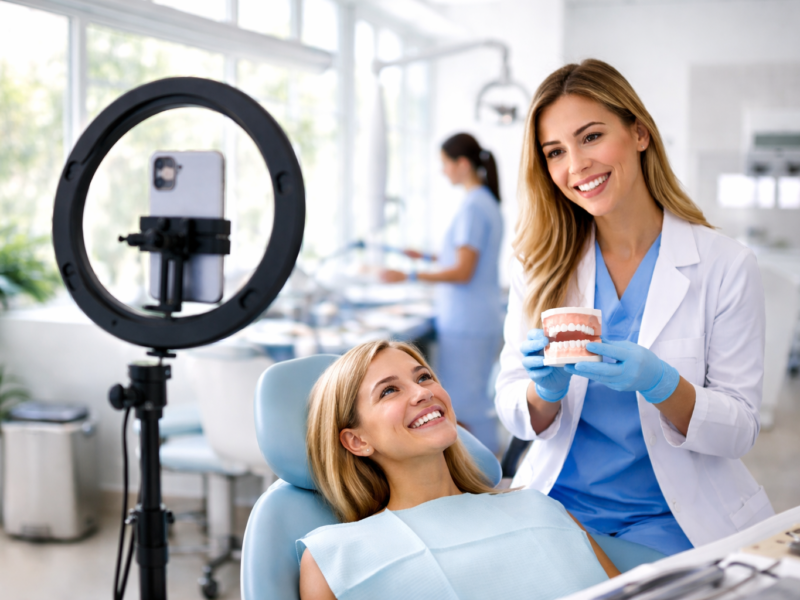
TikTok is no longer a side platform for dance clips, trends, and entertainment only. In 2026, it sits much closer to the top of the discovery funnel for local service businesses, especially if your clinic wants to reach younger adults, parents, and image-first consumers who make fast judgments based on trust, clarity, and visual polish. Recent research shows that 41% of Gen Z now turn to social platforms first when they search for information, ahead of traditional search engines at 32%. SOCi’s 2024 consumer research also found that 62% of Gen Z used TikTok for local business discovery, which matters for dental clinics because people increasingly research providers the same way they research restaurants, gyms, and med spas, by scanning visuals, reviews, and social proof before they ever visit a website.
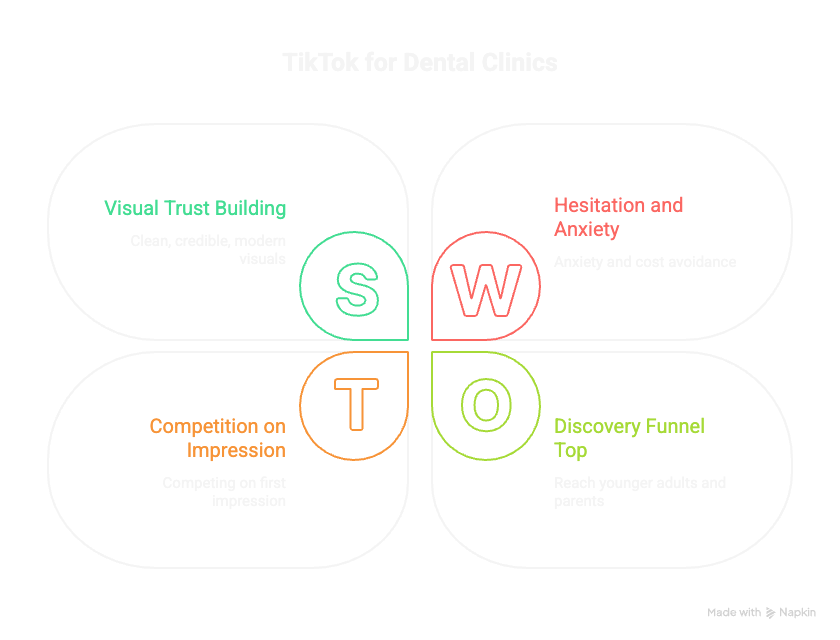
That shift changes what “good marketing” looks like for a dental clinic. You are not only competing on clinical skill. You are competing on first impression, emotional safety, professionalism, and whether your content feels current without looking careless. This matters because oral health is still shaped by hesitation and anxiety. Delta Dental’s 2025 nationwide report found that 21% of adults avoided dental care because of anxiety, while a 2025 Statistics Canada release found that 24% of Canadians aged 12 and older had avoided an oral health professional at least once in the previous 12 months because of cost. When people are already nervous, skeptical, or price-sensitive, weak visuals can increase resistance. Strong visuals can reduce it by making your clinic feel clean, credible, modern, and human.
This is why improving photos on TikTok is not a cosmetic task. It is a booking task. The clinics that do well on the platform usually make people feel something useful within seconds. They make treatment feel understandable. They make staff feel approachable. They make the environment feel safe. They make outcomes feel real, but not exaggerated. TikTok’s own 2025 trend report points to the same direction. Brands perform better when they share varied, unfiltered, behind-the-scenes, and genuine content that builds rapport instead of looking overly manufactured.
Section 1: TikTok Setup and Basics
Why TikTok matters for a dental clinic in 2026
If your clinic still treats TikTok as optional, you are likely missing patients before they ever search your name on Google. BrightLocal’s 2026 Local Consumer Review Survey found that 97% of consumers read reviews for local businesses, 41% always read reviews when browsing, and consumers now increasingly turn to video-based sites for local recommendations. BrightLocal also found that 74% care only about reviews written in the last three months, and 37% say an owner response to a review matters when deciding whether to use a business. In other words, people want recent proof, visible activity, and signs that a business is alive and listening. TikTok helps supply that proof through visuals that feel current, not static.
The platform itself also supports photo-based posting more than many clinic owners realize. TikTok supports photo uploads, additional photo and video clips in a single post, text overlays, sound, editing tools, and even AI-assisted editing within the app. That means a dental clinic does not need a full studio team to publish polished content consistently. A well-shot smartphone photo series, paired with clean cropping, simple text timing, and a useful caption, can become a strong educational or trust-building asset.
Creating a profile that helps photos convert into appointments
Your profile has one job. Reduce uncertainty fast. On TikTok, your profile picture, username, bio, pinned posts, and booking path all need to work together. Keep your clinic name consistent with your Google Business Profile, Instagram, and website. Use a crisp logo or a tightly framed exterior or interior brand image if your logo is unreadable at small sizes. TikTok’s own support pages note that your nickname, username, and profile photo remain visible broadly, so this is not a place for experimentation. It is a place for clarity.
Your bio should state what you do, where you are, and why a patient should trust you. Avoid writing like an ad. Write like a calm front desk lead who knows what nervous patients need to hear. That usually means a location, two or three core services, and one practical action such as “Book consult” or “New patients welcome.” Then make the path friction-light. If you use a website link, send users to a page with mobile booking, insurance information, financing details if applicable, and a clear phone number. Prestige Smile Clinic’s 2026 TikTok case study is useful here. The clinic used in-app lead generation and instant messaging to reduce friction, achieved a cost per conversion of $1.90, converted 10% of leads into actual appointments, and reported a 70% clinic-visit-from-booking rate. Their success did not come from prettier creative alone. It came from pairing visual clarity with fast next steps.
Section 2: Common Mistakes to Avoid
Mistake one: posting like a brochure
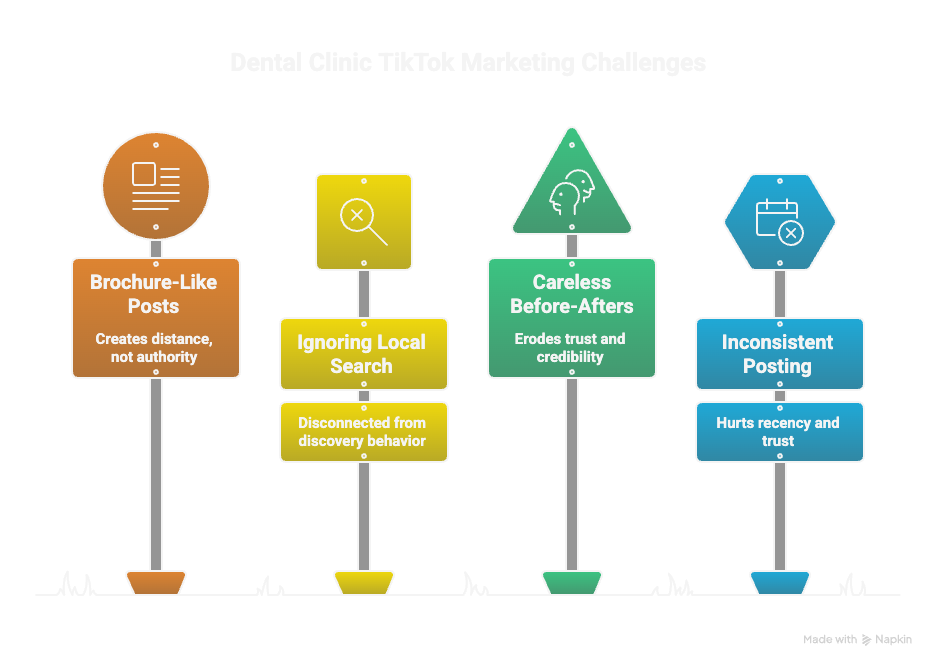
The fastest way to make dental content underperform is to make every post look like a poster. Clinics often add too much branding, too much offer language, too much text, and too much polish. On TikTok, that often reads as distance, not authority. The platform’s own 2025 trend report stresses that users respond to genuine rapport, behind-the-scenes moments, and content that reflects real life. For dental clinics, that means photos of sterile trays prepared for the day, a hygienist setting up a room, a smile reveal with proper consent, a whitening shade comparison under controlled light, or a calm first-visit walkthrough. These all tend to feel more believable than stock-like campaign assets.
Mistake two: ignoring local search behavior
A clinic can post great visuals and still fail because the account is disconnected from how people actually discover local businesses. Social search is now a real local behavior. SOCi found that TikTok is one of the most-used apps for local business information among younger consumers, and Sprout Social found that across age groups, 35% of consumers prefer social first when searching for local restaurants and activities, while 37% prefer it first for product reviews and recommendations. Dental clinics are affected by the same behavior pattern because treatment choice is often influenced by visual reassurance, peer validation, and the sense that “people like me go here.” If your account never mentions location, neighborhood, service area, or common patient questions, your photos may attract attention but fail to attract bookings.
Mistake three: using before-and-after photos carelessly
Before-and-after content can work extremely well in dentistry, especially for whitening, aligners, cosmetic bonding, smile design, and restorative work. But this is one of the easiest areas to get wrong. The issue is not just ethics. It is trust. If lighting, angle, crop, and facial position change too much between images, viewers may assume manipulation. Regulatory guidance also matters. The Royal College of Dental Surgeons of Ontario says dentists should protect patient privacy, maintain professional boundaries, and approach online marketing and advertising carefully. More broadly, Canadian dental ethics commentary has stressed truthful, non-misleading claims and responsible use of patient imagery across provinces. So use explicit consent, consistent framing, realistic captions, and plain explanations of what treatment was actually performed.
Mistake four: inconsistent posting and weak visual standards
Many clinics post in bursts, then disappear. That hurts performance because recency matters in local trust. BrightLocal found that 74% of consumers care about reviews from the last three months, and 47% will not use a business with fewer than 20 reviews. While those numbers refer to reviews, the same buyer mindset affects social content. People want signs of an active business. A dormant TikTok account with outdated photos can make a clinic feel dated, understaffed, or less trusted than a competitor with modest but current content.
Section 3: Improving Your Photos
Start with what your patients actually want to see
The best dental photos are rarely the most dramatic. They are the most reassuring. Recent patient research in British Columbia found 77% overall satisfaction with oral health care experiences, but satisfaction was much lower on specific operational touchpoints such as emergency access at 53% and clarity around costs at 57% for pre-treatment information about recommended treatment costs. That tells you what your photography should support. Show cleanliness, team warmth, equipment quality, transparency, process, and comfort. Show the space where people will sit. Show the clinician’s eyes, not just the tools. Show what a first visit looks like. Show what happens before, during, and after treatment. Photos should reduce the unknown.
Use lighting that flatters teeth and skin without distorting reality
Dental content lives or dies on lighting. Harsh overhead light can add shadows, flatten enamel, and make gums or skin tones look unhealthy. Mixed lighting can make whitening results look fake. The safest setup for most clinics is soft, even light near a window or under balanced daylight LEDs, plus a consistent background. For treatment-result photography, standardize the setup. Same chair position. Same angle. Same distance. Same camera. Same exposure range. Same lip position if clinically appropriate. This keeps your content believable and repeatable.
For non-clinical photos, aim for warmth and clarity. Reception images should feel bright and calm. Staff photos should feel confident and friendly, not stiff. Procedure prep photos should feel clean and organized. On TikTok, where people scroll fast, clean light often matters more than expensive gear.
Composition matters more than expensive equipment
Most clinics do not need to start with a DSLR. A newer smartphone can be enough if you control angle, background, and steadiness. What matters is composition. Fill the frame with one clear idea. If the photo is about a smile reveal, make the reveal the subject. If it is about your hygienist explaining home care, show eye contact and the tool being discussed. If it is about your clinic environment, remove clutter. Hide cords, disposable packaging, random paperwork, and anything that signals chaos.
This is especially important because viewers use photos to judge clinic quality indirectly. BCCOHP’s 2025 patient report showed satisfaction levels were tied to communication, rapport, safety, and expectations being met. Your photography should visually support those exact outcomes. A tidy treatment room, calm clinician expression, and organized tray setup communicate competence before a word is read.
Build photo content around four dependable categories
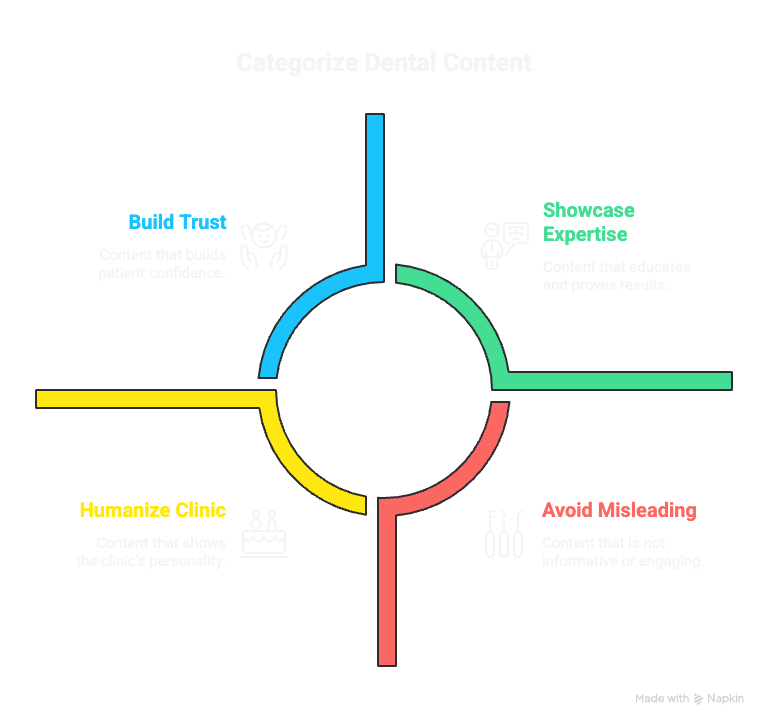
If your clinic struggles to know what to shoot, focus on four content buckets.
First, trust photos. These include team headshots, candid staff interactions, sterilization and setup visuals, reception images, and “what to expect” first-visit walkthroughs.
Second, education photos. These include shade comparisons, aligner stages, oral hygiene demonstrations, bite issues, retainer care, and common questions like “What happens during a crown consult?” or “How long does whitening sensitivity last?”
Third, proof photos. These include compliant before-and-afters, patient testimonial stills with consent, milestone photos, and case progress sequences.
Fourth, culture photos. These include community events, birthday moments, continuing education days, charity drives, and behind-the-scenes snapshots that make your clinic feel human.
TikTok’s trend guidance favors this mix because it rewards brands that show more than one polished version of themselves. Genuine range creates trust.
Edit for clarity, not transformation
TikTok’s editing tools allow you to upload photos, add more clips, add sound, place text, and use in-app editing. TikTok Studio also includes a photo editor with filters, stickers, and crop settings. Use these tools with restraint. Dental content is a trust category, not a fashion category. Your edits should improve readability and consistency, not change reality. Increase brightness slightly if needed. Adjust white balance so teeth do not turn blue. Crop tighter so the subject fills the screen. Add simple on-screen text that explains what the viewer is seeing. Avoid beauty filters, heavy skin smoothing, extreme whitening, or any adjustment that could make outcomes look clinically misleading.
One smart workflow is to edit the base image outside TikTok for color and sharpness, then use TikTok only for platform-native additions such as text timing, sound, sequencing, and cover selection. This preserves image quality while still making the post feel native to the app.
Protect privacy and moderate the conversation
Dental clinics work in a regulated, sensitive environment. Every photo featuring a patient needs documented consent, clear internal approval, and attention to what appears in the frame. Remove charts, monitors, names, prescription details, and any identifying paperwork. The RCDSO guidance explicitly highlights patient privacy, online professionalism, and care in advertising. On the engagement side, TikTok offers comment filters, keyword filters, and Creator Care Mode. Clinics should use them. Health-related comment sections can quickly become risky if left unmanaged.
Section 4: A Simple Measurement Plan
Define success in business terms, not vanity terms
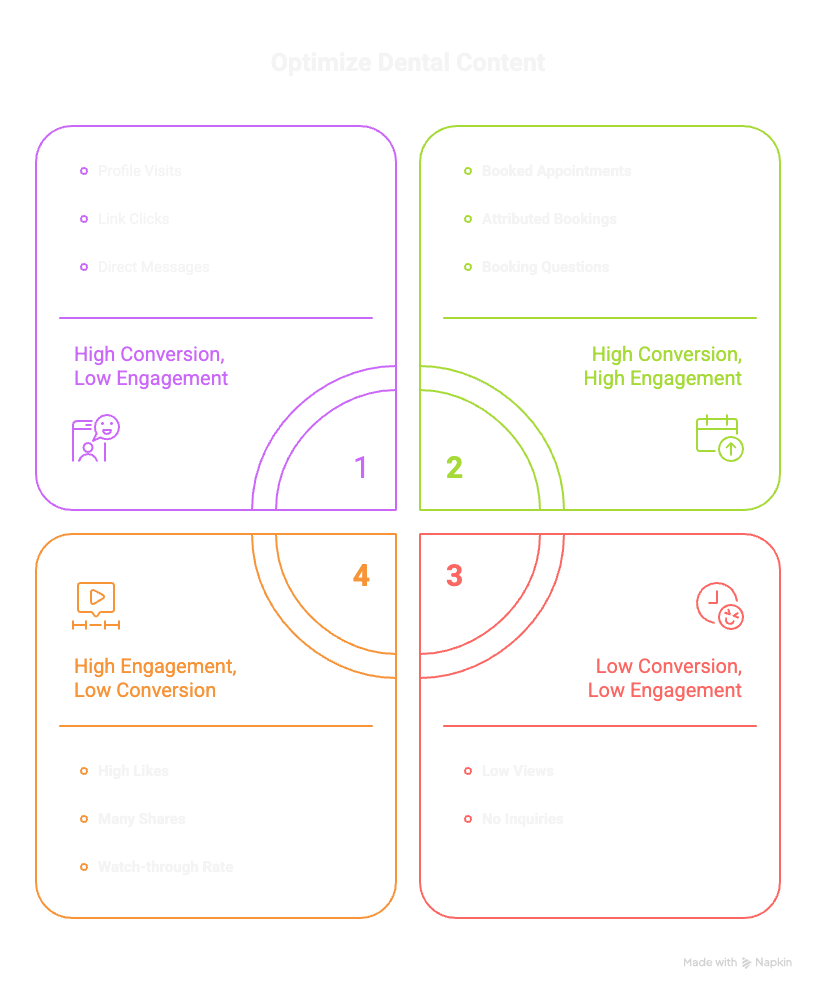
A dental clinic does not need millions of views. It needs the right views from the right local audience that lead to consultations, calls, form fills, and booked appointments. Start with four primary goals: profile visits, link clicks, direct messages, and attributed bookings. Track secondary indicators too, such as saves, shares, watch-through on photo carousels, and comments that ask booking-related questions.
Do not stop at likes. TikTok case studies in healthcare and dental categories show that lower-friction paths matter more than surface engagement. Prestige Smile Clinic paired creative with instant forms and messaging to drive real appointments, while Teeth Talk Dental Clinic improved efficiency with Smart+ Cost Cap and Messaging Ads, leading to a 20% decrease in CPA, a 50% lower CPM, and a 14.7% increase in conversion rate. Those are useful reminders that content quality and conversion design need to work together.
Track content by photo type, not only by post date
Most clinics review content too broadly. Instead, group every post by type: team, office, before-and-after, educational, testimonial, community, or treatment process. Then compare results over 30, 60, and 90 days. You will usually find that one or two categories outperform the rest in both engagement and booking intent.
For example, a reception photo might generate fewer likes than a whitening reveal, but it may drive more profile visits because it lowers first-visit anxiety. A close-up procedure image may underperform if it feels too clinical, while a dentist explaining a smile transformation with one still image and a calm voiceover may perform better because it combines authority with safety.
Review monthly, adjust quarterly
A monthly review cycle is enough for most clinics. Check which photo posts drove the most profile views, DMs, link clicks, and booking inquiries. Look at your top three posts and ask what they had in common. Was it brighter lighting? Better staff presence? A more useful caption? A stronger opening image? A more specific local hook? Then make one deliberate adjustment next month, not ten random changes.
Quarterly, compare your TikTok activity against bookings, review growth, and branded search interest. This matters because trust is cumulative. BrightLocal’s latest research shows that people increasingly verify businesses across several review sources, and many expect a business to have both a strong rating and fresh proof. TikTok can support that wider trust ecosystem by making your clinic feel current and credible before the patient checks Google reviews or your website.
Wrapping Up
Improving photos on TikTok for your dental clinic is not about chasing aesthetics for their own sake. It is about reducing uncertainty, showing professionalism, and turning visual trust into booked care. In a market where 97% of consumers read local business reviews, 41% of Gen Z search social first, and a meaningful share of patients still avoid care because of anxiety or cost, your photos need to do practical work. They need to make your clinic look clean, current, approachable, and worth contacting.
The clinics that win on TikTok in 2026 are usually not the loudest. They are the clearest. They show real people, real spaces, real outcomes, and real next steps. Start by tightening your profile. Standardize your lighting. Build repeatable photo categories. Edit lightly. Protect privacy. Measure what leads to contact, not what flatters the ego. Done consistently, that process can turn a simple photo strategy into a reliable booking channel.
Discover more from The Digital Cauldron
Subscribe to get the latest posts sent to your email.