Introduction: Why Instagram and SMS belong together for restaurants in 2026
Restaurant marketing in 2026 is won on the phone screen. Discovery starts there, comparison happens there, and a large share of purchase intent either strengthens or dies there. Instagram matters because it remains one of the largest attention platforms in the world. Reuters reported that Instagram reached 3 billion monthly active users in September 2025, while DataReportal showed Instagram ads could reach 1.74 billion users in January 2025, up 5.5% year over year. That scale matters for restaurants because diners do not need much friction to move from “that looks good” to “let’s go tonight.” 
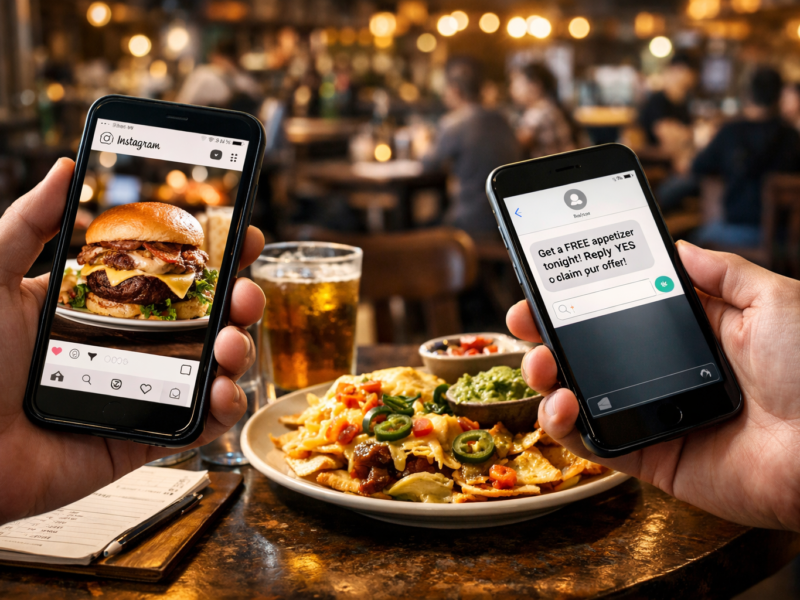
For restaurants, Instagram is strongest when it does one job well: create appetite, signal relevance, and prompt an immediate next step. SMS is that next step. Instagram is public, visual, and discovery-oriented. SMS is direct, permission-based, and built for urgency. One channel gets attention. The other converts it. Klaviyo’s 2026 SMS benchmarks show that behavior-triggered SMS performs especially well, with flow-based SMS click rates nearing 10% on average and top performers exceeding 16%. Those same SMS flows account for only 7.6% of sends but drive 45.2% of total SMS revenue, which tells you something important: the money is often in timely, high-intent messages, not broad blasts. 
That is why restaurants should stop treating Instagram as a place to “post content” and start treating it as a feeder system into owned demand. Followers do not pay rent. Opted-in SMS subscribers often do. SMS gives you a faster path to bookings, walk-ins, delivery orders, event fills, and slow-day recovery because you are not waiting on an algorithm to decide whether your audience will see the message. The most practical use of Instagram is not vanity reach. It is list growth, repeat visits, and measurable revenue. Blaze Pizza, for example, found that Attentive SMS drove a 13%+ revenue lift versus a control group, while Klaviyo highlights restaurant brands such as Eureka! Restaurant Group driving 43x ROI and Pi Co. generating 54% of Klaviyo-attributed revenue from email and SMS automations. 
The opportunity is larger because restaurant discovery has become fragmented. Toast’s 2026 restaurant discovery data found that word of mouth still leads at 38% and physical pass-by at 30%, but digital channels now make up the next layer of influence, with Facebook at 27%, Instagram at 15%, YouTube at 15%, TikTok at 14%, map apps at 18%, and search results at 16%. In other words, a restaurant no longer wins because it is good. It wins because it is visible, believable, and easy to act on. Instagram gives you visibility. SMS gives you action. 
This guide shows you how to build that system in a tight 45-minute sprint. It is meant for working restaurants, not theory. You can use it whether you run a single-location café, a neighborhood dine-in concept, a QSR, a delivery-heavy brand, or a multi-unit group that wants faster returns from social.
Setting the stage: your Instagram setup and basics
Before you ask Instagram traffic to join your SMS list, your account needs to feel credible, current, and useful. A weak profile kills opt-ins because people do not trust what feels neglected. Your Instagram page must answer four questions in under ten seconds: what kind of restaurant are you, where are you, why should someone care, and what should they do next. That means your profile photo should be recognizable, your category should be accurate, your bio should include cuisine and location, and your link path should be obvious. If you are sending people to a text club, say so directly. If you want them to text a keyword, make that the clearest call to action on the page. 
You also need to understand what people want to see before they subscribe. Toast’s restaurant social media study found that 84% of respondents prefer to see photos of food and drinks on a restaurant’s social pages, 62% sometimes check a restaurant’s social media before deciding to dine there, and 43% say it is very important that restaurants respond to comments or messages on social media. The same research found that 57% say pictures of food influence their decision to visit, 47% want to see décor and ambiance, 44% want promotions, and 38% want videos of the dining experience. That tells you exactly what your Instagram feed should do before you ever ask for a text opt-in. It should reduce doubt and increase desire. 
Your Business or Creator setup also matters because you need access to insights, content tools, ad options, and profile action buttons. On Instagram, the best-performing restaurant accounts do not look like static brochures. They look alive. They show signature dishes, service moments, packed nights, limited-time specials, and reasons to return this week, not someday. Socialinsider’s 2026 Instagram benchmark data shows carousel posts held the strongest engagement resilience, with average carousel engagement at 0.55%, while Reels remained important but no longer guaranteed a lift on their own. That means restaurants should not overbet on one format. Use carousels to tell the story of an offer or meal experience. Use Reels to show motion, atmosphere, preparation, or a fast before-and-after of the guest journey. 
Your SMS offer must also be visible in more than one place. Put it in your bio. Put it in Story Highlights. Mention it in captions. Use Stories to repeat it weekly. Add it to comment replies when appropriate. Feature it in pinned posts. A good prompt is simple and specific: “Text PASTA to [number] for first-access specials, event drops, and VIP offers.” The key word here is specific. CTIA guidance emphasizes clear and conspicuous calls to action, including the identity of the sender, what the consumer is signing up for, how to opt out, customer care information, and any fees or message frequency disclosures. If your CTA is vague, you create risk and reduce conversion. 
The strongest setup for restaurants is a clean exchange of value. Do not ask guests to join because you want to “stay in touch.” Ask them to join because you will give them something worth receiving. Early access to weekend reservations. VIP-only tasting invites. a bounce-back offer for weekday traffic. a birthday perk. a secret menu item. a game-day combo. a rain-day delivery code. a lunch flash special between 11 a.m. and 1 p.m. The more concrete the value, the higher the opt-in intent.
Avoiding common mistakes in SMS marketing on Instagram
The first mistake is treating SMS like louder email. It is not. People tolerate inbox clutter. They do not tolerate irrelevant texts. The cost of getting SMS wrong is high because the channel feels personal and interruption-heavy. Klaviyo’s 2026 benchmark data makes the lesson clear: triggered flows outperform broad campaigns because context matters. Restaurants that rely on constant promo blasts train customers to ignore them, wait for discounts, or opt out altogether. 
The second mistake is poor compliance hygiene. In the United States, restaurant marketers using automated or marketing texts need to work within TCPA and carrier rules. FCC guidance states that telemarketing robocalls and robotexts require prior written consent, and the FCC’s consent order clarified that consumers must be able to revoke consent in any reasonable manner, with do-not-call and consent revocation requests honored within no more than 10 business days. The FCC also limits text senders to one final confirmation text after opt-out in that context. CTIA best practices add that consumers should be able to opt out at any time, and senders should acknowledge and respect those requests. For restaurants, that means your opt-in records, disclosures, message frequency, keyword flows, privacy policy access, and opt-out handling cannot be sloppy. 
The third mistake is weak consent capture. CTIA states that senders should document consent details such as timestamp, source, phone number, campaign, and the exact experience used to secure consent. It also recommends a confirmation message for recurring campaigns that explains the program, frequency, customer care information, charges, and opt-out method. If you collect numbers through Instagram DMs, a website form, a link-in-bio pop-up, a table tent, or a POS prompt, you need to know exactly where each consent came from and what the guest was told when they signed up. This is not a legal footnote. It is operating discipline. 
The fourth mistake is poor segmentation. Restaurants often send the same message to every subscriber. That is lazy and expensive. A brunch-heavy audience, late-night crowd, office lunch audience, and family dinner segment do not respond to the same offer. Twilio’s 2025 State of Customer Engagement report, based on responses from 7,640 consumers and 637 business leaders, found that brands are pushing toward one-to-one engagement and personalization because loyal customers expect it. A restaurant does not need perfect data to act on this. It just needs a few practical segments: first-time diners, frequent guests, lapsed guests, event subscribers, delivery-first customers, and location-based groups. 
The fifth mistake is underusing Instagram as a listening tool. Your Stories, comments, DMs, polls, saves, and offer-specific post performance tell you what people care about. If a Story about a prix fixe menu gets strong taps and replies, that is signal. If a behind-the-scenes prep Reel gets views but no link clicks, that is signal too. Toast’s social data found that 43% of respondents think replying to comments or messages is very important, and another 48% say it is somewhat important. That means responsiveness is not a nice extra. It affects trust and conversion. 
The sixth mistake is measuring the wrong thing. Instagram likes do not pay for ingredients. SMS list growth alone does not prove business impact. The metric chain that matters is this: content exposure, CTA interaction, opt-in rate, offer redemption, order value, repeat visit rate, and unsubscribe rate. If you stop at impressions, you are measuring attention, not outcomes.
Implementing your SMS marketing strategy in 45 minutes
This 45-minute system works best when you focus on one campaign, one offer, one audience, and one next step. Complexity is what slows restaurant marketing down. The goal of the sprint is not to build a giant automation architecture in one session. It is to launch one clean campaign that can be repeated every week.
Minute 1 to 15: define the campaign goal
Start with one outcome and one time window. Do not say, “We want more business.” Say, “We want 40 incremental covers on Tuesday night,” or “We want 25 delivery orders between 5 p.m. and 8 p.m.,” or “We want to fill 60% of remaining seats for the wine dinner by tomorrow at noon.” Specificity improves everything downstream, from creative to SMS copy to tracking. It also helps your team decide what kind of incentive is actually needed.
Your goal should match a real operational need. If your dining room is strongest on Friday and Saturday, use Instagram-to-SMS for Monday through Wednesday recovery. If you sell out dine-in but struggle with off-peak delivery, build a delivery-only text club benefit. If your high-margin items are under-ordered, structure the offer around those. If you have event inventory to move, use scarcity. Restaurants often think marketing begins with the post. It begins with the business constraint.
The best campaign goals for this type of sprint usually fall into five categories. One is foot traffic, especially for soft days or weather-sensitive trading windows. Another is online ordering, particularly when you want short-term volume. Third is new menu launches, where curiosity is high but awareness is low. Fourth is events, such as tasting menus, live music, holiday brunches, chef collabs, or game-day nights. Fifth is retention, where you invite recent or past guests back with a bounce-back reason that feels timely and personal.
Choose only one. Then define the audience. Is this for everyone who follows you, only locals, lunch buyers, cocktail drinkers, students, office workers, or guests who already know you? Even if your SMS stack is basic, your creative can still speak to a specific person. That improves results.
Finally, pick your offer. Strong restaurant offers are usually simple. “Text TACO for a Tuesday-only combo.” “Text DATE for a limited Friday prix fixe.” “Text LUNCH for a weekday lunch bonus.” “Text VIP for first-access reservations.” “Text PIZZA for a free garlic knot add-on with tonight’s order.” The offer should feel immediate, easy to explain, and worth the interruption.
Minute 16 to 30: craft compelling content that earns the opt-in
Now build the Instagram assets. You do not need a big production. You need clarity, appetite, and urgency. Start with one hero visual. Toast’s 2024 restaurant social study found that 84% want food and drink photos, and 57% say food pictures influence their decision to visit. So use your strongest product image first. Not your dining room exterior. Not a generic brand graphic. The actual item, plated well, lit well, and shown in a way that creates a craving response. 
Then write the CTA so a distracted person can understand it instantly. Good example: “Tonight only. Text BURGER to 555-555-5555 for a late-night combo and first access to future specials.” Better if you also tell them why they should join long-term: “Join our VIP text list for flash drops, event invites, and members-only offers.” CTIA best practices say the call to action should clearly state who is messaging, how to opt out, and what terms apply. So your full sign-up path, whether in bio, landing page, or automated reply, should include that detail clearly, not buried. 
Use one feed post and three to five Stories for the launch. The feed post gives you an anchor. Stories give you repetition and urgency. For the feed, a carousel often works well because you can move from appetite to explanation to action. Slide one can be the hero dish. Slide two can explain the offer. Slide three can explain how to join. Slide four can add social proof, such as “VIP list gets first dibs every week.” Socialinsider’s 2026 benchmark showing carousels at 0.55% engagement supports this approach. 
For Stories, keep each frame single-purpose. Story one should show the food or atmosphere. Story two should state the benefit. Story three should show the keyword or sign-up action. Story four can handle urgency, such as “ends at 8 p.m.” Story five can answer the obvious question, like dine-in only, valid location, or first-time subscriber rules. If you are running multiple locations, geo-specific Story variants are worth the extra five minutes because relevance lifts response.
This is also the point where most restaurants either win or lose. They make the content look good, but they do not make the action easy. The ideal path is one tap or one text, not five steps. If you use a link-in-bio landing page, keep it stripped down. If you use a keyword opt-in, make sure the number is impossible to miss. If you ask people to DM you for access, have the reply flow ready immediately. Friction is not a design problem. It is a revenue problem.
Minute 31 to 45: launch, respond, and monitor early signals
Publish the feed post, then post the Stories in sequence. Pin the feed post if the offer runs longer than a few hours. Watch replies and comments closely in the first 15 to 30 minutes. Restaurants that respond fast pick up more conversions because the intent is warm. Toast found that social responsiveness matters to diners, and in practice that means answering “Is this dine-in only?” or “Can I use this tomorrow?” can be the difference between a conversion and a lost guest. 
This is also where you should collect signal, not just numbers. Are people confused about the offer? Are they asking whether the deal works for takeout? Are they interested in the item but not the day? That feedback improves your next campaign. One of the hidden strengths of Instagram-to-SMS is how quickly it can become a learning system. You are not waiting weeks for a report. You can see language-market fit in real time.
If you want to stretch performance without adding major time, do one more thing before the 45 minutes end. Add a quick follow-up Story that answers the most common question from the first few replies. That single frame often lifts conversion because it removes hesitation for the silent majority who saw the post but did not ask.
A well-run launch does not stop at posting. It stays live for the first response window. That is what turns a campaign into a result.
Building a robust measurement plan
A restaurant should never run Instagram and SMS in separate reporting silos. The whole point of using them together is to understand the journey from exposure to action. Start with a baseline. What is your current SMS list size, average weekly opt-ins, average weekday covers, average online orders, average check size, and average engagement on similar Instagram content? Without a baseline, every future result becomes guesswork.
Then define the metrics that matter for this exact campaign. At the top of the funnel, track reach, Story views, profile visits, link clicks, DMs, and comments. In the middle, track opt-ins, opt-in rate by asset, and source of consent. At the bottom, track redemptions, orders, bookings, revenue, average order value, repeat visit behavior, and unsubscribe rate. Klaviyo’s 2026 SMS benchmark guidance is useful here because it centers click rate, order rate, revenue per recipient, and unsubscribe rate. Those are better restaurant metrics than generic “engagement” alone. 
Triggered messaging deserves its own measurement lane. Klaviyo found that SMS flows drive 45.2% of total SMS revenue despite representing just 7.6% of sends, and nearly 64.4% of SMS flow revenue comes from new buyers. That means your welcome flow, first-offer flow, birthday flow, post-visit bounce-back, cart reminder, or event reminder may matter more than your weekly broadcast. Restaurants often spend too much time debating creative and too little time measuring automated intent moments. 
Segment-level reporting is where the real gains appear. Compare first-time subscribers versus repeat guests. Compare weekday lunch subscribers versus weekend dinner subscribers. Compare location A versus location B. Compare bio-link opt-ins versus keyword opt-ins from Stories. When you find a segment that converts at a higher rate, do not just “note it.” Build a repeated campaign for that cohort. This is how restaurant marketing gets more efficient without needing a giant budget.
Attribution also needs realism. Instagram may create awareness while SMS closes the sale. A guest may see a Reel on Wednesday, join by text on Thursday, and dine on Saturday. If you insist on last-click thinking, you will under-credit the social content that built the demand in the first place. This is one reason integrated platforms matter. Klaviyo’s restaurant case studies point to the value of having customer data, messaging, and conversion tracking in one place. Pi Co. specifically credits the Square and Klaviyo integration with making it easier to centralize data and track marketing impact through to conversion, while Eureka! Restaurant Group highlights the ability to measure exact results across teams. 
A simple review rhythm works best. Do a 24-hour read, a 7-day read, and a 30-day read. In the first 24 hours, you are looking for clear wins or friction points. In 7 days, compare results against similar dayparts and prior periods. In 30 days, assess whether this should become a recurring campaign, an automation, or a retired experiment. If it drove list growth but weak revenue, your offer may be attracting low-intent subscribers. If it drove strong redemptions but high unsubscribes, your targeting or message expectations may be off. If it drove modest opt-ins but excellent repeat visits, you may have found a high-quality retention lever.
Compliance and operational discipline that protect performance
Good compliance is not the enemy of strong marketing. It is part of strong marketing. FCC and CTIA rules exist because messaging is a high-trust channel. If guests feel tricked, spammed, or unclear about what they signed up for, they do not just opt out. Carriers may also block messages, deliverability can suffer, and your brand takes the hit. FCC materials make clear that written consent matters for marketing robotexts, one-to-one seller consent matters, and revocation must be honored in any reasonable manner within the required timeframe. CTIA adds practical expectations around clear calls to action, documented opt-in records, visible privacy policies, and accessible opt-out methods. 
For restaurants, this means your Instagram CTA should never be fuzzy. The guest should know they are joining a recurring text program, who it is from, what type of messages to expect, how often roughly to expect them, and how to stop them. The confirmation text should reinforce those expectations. CTIA guidance also states that opt-out instructions should use standard STOP language, while normal-language requests such as stop, end, unsubscribe, cancel, quit, or “please opt me out” should also be honored. That is a practical point many operators miss. Your systems should be built to respect natural customer behavior, not force perfect behavior. 
Keep records. Keep screenshots of the sign-up flow. Keep timestamps. Keep source data. Keep campaign naming consistent. Keep privacy links accessible. If your team changes agencies, vendors, or tools, these records protect you and preserve continuity. The restaurants that treat SMS as a serious channel tend to outperform the ones that treat it like a quick promo toy.
What strong restaurant use cases look like in practice
A weekday recovery campaign is one of the easiest wins. Suppose Tuesdays are soft. You post a carousel at 11 a.m. showing your signature burger, fries, and drink. The CTA invites followers to text BURGER for a same-day dinner perk and access to future weekly drops. Your Story sequence repeats the offer twice between lunch and late afternoon. Subscribers get a confirmation, then a timed offer text around 4 p.m. This works because Instagram handles appetite and awareness, while SMS hits the decision window when guests are actually choosing dinner.
A second use case is event fills. Wine tastings, game nights, Ramadan iftars, brunch launches, chef’s table dinners, and holiday seatings benefit from a VIP text list because inventory is finite and urgency is real. Instagram content can make the event feel desirable, but SMS is better for “only 12 seats left” or “book by 6 p.m. today.” This is where the channel mix shines.
A third use case is menu launches. If you are testing a new item, Instagram is the public teaser and SMS is the private early-access list. This can create a feeling of membership without heavy discounting. Restaurants that rely only on discounts to grow lists usually build weaker lists. Restaurants that offer status, access, convenience, or insider timing often build better ones.
A fourth use case is loyalty reactivation. If someone has not returned in 30 or 45 days, SMS is far stronger than hoping they happen to see your post again. Instagram can still support this by running organic proof that the place is active, busy, and worth revisiting. But the nudge should be owned. This is also where personalization matters. A guest who came for brunch should not get a late-night wings offer unless you have evidence they want it.
The broader point is that Instagram and SMS should not compete for credit. They should work together. Twilio’s engagement research reflects the larger market direction toward more personalized, one-to-one communication, and restaurant brand case studies from Attentive and Klaviyo show that once messaging is tied to customer data and intent, measurement improves and returns become much easier to justify. 
Conclusion: the power of integrated restaurant marketing
Instagram is where many guests first feel your brand. SMS is where many of them finally act. When you pair them properly, you turn passive attention into owned demand. You stop renting reach and start building a list you can use to fill seats, recover slow shifts, move inventory, launch products, and bring guests back faster.
The mistake many restaurants make is assuming that growth will come from posting more. The better model is this: post with purpose, capture consent clearly, follow up with relevance, and measure against revenue. The data supports that approach. Instagram remains massive, restaurant discovery is now fragmented across several touchpoints, diners check social before choosing where to eat, visual content influences real decisions, and SMS performs best when it is timely and behavior-based. 
If you execute the 45-minute sprint well, you do not just get one campaign. You get a repeatable operating model. One offer. One audience. One clean path to opt in. One measured outcome. Run it weekly, improve it monthly, automate the best parts, and over time your Instagram account stops being a gallery and starts becoming a revenue engine.
Discover more from The Digital Cauldron
Subscribe to get the latest posts sent to your email.