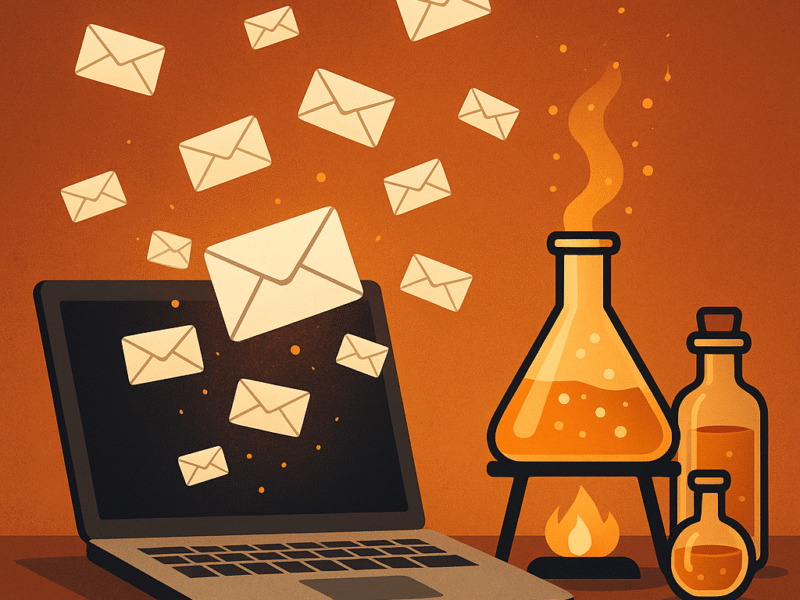
Brewing Business Through the Inbox
Unveiling TDC’s Proven Email Marketing Strategies that Turn Subscribers into Loyal Customers
Mastering email marketing is no longer a competitive advantage; it’s the price of admission for businesses serious about predictable, scalable growth. In an era where digital marketing costs are climbing and consumer attention spans keep shrinking, email stands as one of the few channels that offer consistent returns and intimate audience reach. If you’re aiming to supercharge your customer lifecycle, email is your most potent ally. At TDC, we treat email marketing as both an art and a science — what we call “Email Alchemy.” It’s not about flooding inboxes with noise; it’s about crafting high-intent touchpoints that convert cold leads into sales-qualified conversations and passive subscribers into raving fans. In this in-depth playbook — inspired by our webinar Email Alchemy: Brewing Business Through the Inbox — we’ll explore how to: – Write click-enticing subject lines using powerful copy triggers – Use behavioral data and AI personalization to build hyper-relevant messaging – Automate customer journeys with lifecycle marketing that scales – Design email loyalty programs that foster deep brand affinity Whether you’re launching an e-commerce store, scaling a SaaS solution, or leading growth at an agency, this guide delivers actionable insights grounded in proven frameworks and results. Let’s get brewing.
Why Email Marketing Still Dominates Digital ROI
Despite the rising buzz around newer channels like TikTok Ads, influencer partnerships, or native sponsorships on YouTube, email remains the highest-performing digital channel in terms of ROI. And the data backs it up thoroughly across industries.
The Cold, Hard Stats:
– ROI King: Email generates an average return of $36 for every $1 spent, according to Litmus — beating social media, PPC, and affiliate marketing. – Universal Usage: As of 2024, there are over 4.48 billion email users globally — more than half the world’s population (Statista). – Consumer Preference: A study by MarketingSherpa shows that 72% of consumers prefer to receive promotional content via email, compared to just 17% who prefer social media. – Retention-Oriented: Welcome emails see an open rate of 82% on average (GetResponse). This makes email a critical channel post-acquisition.
Why It Still Works:
– Direct, Personal Access: Unlike social media feeds that are curated by algorithms, email gives you a dedicated real estate in a user’s inbox. It’s the closest digital equivalent to a one-on-one conversation. – First-Party Data Leverage: With increasing privacy restrictions (like iOS 17’s Mail Privacy Protection and the death of third-party cookies), email lists represent zero-party and first-party data — the cleanest audience source. – Low CAC, High LTV: Combining email marketing with customer data platforms (CDPs) and behavior-based automation increases Lifetime Value (LTV) without escalating customer acquisition costs (CAC). Marketing teams that understand this shift harness email not as a retrofit communication tool, but as a primary revenue engine.
1. The Secret Science of Subject Lines: Captivate in 45 Characters or Less
First impressions matter — and in email marketing, your subject line is often the only gatekeeper between obscurity and engagement. You get about 1.5–2 seconds to capture attention in a sea of competing content. That’s why we obsessively engineer subject lines that perform. At TDC, our in-house conversion scientists utilize what we call the “C.U.R.V.E. Method” — an acronym built from a decade of A/B test results and psychological triggers proven to increase open rates across multiple verticals.
The C.U.R.V.E. Subject Line Framework:
– 🧠 C – Curiosity: People can’t resist information gaps. Try something like: “The surprising tactic we used to 10X conversions last month” – ⏰ U – Urgency: Limiting time or availability encourages action: “Final hours: 50% off our email funnel playbook” – 🎯 R – Relevance: Match language to the subscriber’s intent or segment-specific pain points: “Struggling to onboard new hires? You’re not alone…” – 📦 V – Value: Highlight immediate benefits clearly: “Free Checklist: 7 Mistakes Could Be Costing You Clicks” – ❤️ E – Emotion: Use language that connects empathetically: “We’ve all felt stuck. Here’s how we broke through.”
Case Study: Doubled Opens, Same List
In Q3 2023, one of our B2B SaaS clients used the subject line: “Software Update V2.3 Released.” Open rate: 18.2% We reengineered it to read: “New Features Just Dropped (Here’s How We’re Saving You 7 Hours/Week)” Resulting open rate: 39.7% — a 118% lift.
Testing & Tools:
Always A/B test 2–4 subject line variants targeting different emotional or logical triggers. Tools like SendCheckIt and CoSchedule’s Headline Analyzer can help grade readability, sentiment, and spam score. Subject lines aren’t just about opens — they signal your brand voice, the promise of value, and even trigger subconscious buying behavior. Treat them like the headlines of million-dollar copywriting campaigns — because they often are.
2. Personalization: Beyond First Names to First-Class Experiences
If audience segmentation is the GPS of modern email marketing, personalization is the route optimization tool. Today’s consumers demand more than canned greetings — they expect relevance at every touchpoint. TDC’s personalization matrix is built across three integrated personalization tiers. These aren’t just fancy labels — they represent revenue-driving workflows that impact lifecycle performance.
Tier 1: Demographic Personalization (Static Attributes)
This is foundational — using unchanging characteristics like: – Location and timezone – Industry or company size – Job title or department 🔍 Example Workflow: If your CRM flags a recipient as a “Midwest-based Marketing Director,” send them industry-trend insights tied to regional data, like: “Why Midwest Marketers See 7% Higher ROI from Localized CTAs” This approach raised click-through rates by 13–26% for our clients when paired with regionally relevant subject lines and content blocks.
Tier 2: Behavioral Personalization (Dynamic Triggers)
Behavior-based content adapts in real time based on: – Email opens and click patterns – Site visits – Product views or cart activity 📈 Example: If a user clicked on an email about SEO strategy but didn’t convert, follow up with a micro-case study or training tip showcasing results: “How This Funnel Drove $142K in Organic Conversions — With Zero Paid Ads” Tools like HubSpot, ActiveCampaign, and Iterable make behavioral workflows seamless to build, enabling near-real-time triggers.
Tier 3: Predictive Personalization (AI & Analytics)
AI-powered personalization anticipates what your customer needs before they know it. This is where platforms get smart using machine learning models that forecast: – Likelihood to purchase or churn – Recommended products/services – Preferred send times and engagement cadence 💥 Example Campaign: Our AI-driven restock cadence triggered emails to power tool buyers just before their average refill period, increasing repurchase rate by 28% in 60 days. When data-driven personalization is applied cohesively, you’re no longer “marketing.” You’re conversing intelligently — and customers notice the difference.
Email Alchemy — Part 2
Automations, Loyalty, KPIs, Case Studies, and How TDC Puts It All to Work If Part 1 was the recipe, Part 2 is the kitchen in full motion—timers humming, funnels simmering, revenue baking in the background. Below, we go deep on the plays that compound LTV, lift profit, and free your calendar.
Advanced Automation Tactics That Drive Revenue in Your Sleep
Great brands don’t “blast.” They orchestrate. These are the automations that keep working while you’re offline.
1) The Signal Reactor (micro-intent engine)
Capture every micro-signal—viewed a product/service page, downloaded a guide, clicked a “pricing” link, watched a demo, hovered on “add to cart,” searched your help docs—and turn it into a next-best action. Trigger examples: “Pricing page + no signup” → send 2-step objection handling series. Creative angle: Mirror the signal in the message: “You were looking at our Growth plan—here’s how teams like yours use it to cut onboarding time by 42%.” Guardrails: Cap frequency per user per 48 hours to protect deliverability.
2) Predict-&-Prevent Churn
Use simple RFM + engagement scoring to predict who’s fading, then intercept. Inputs: Days since last open/click, last purchase/usage, ticket history, NPS. Plays: Early risk: education + quick-win checklist. Mid risk: personal “Can I help?” founder note + 1 value-packed tutorial. Late risk: save offer, downgrade path, or pause-and-resume.
3) Affinity-Aware Cross-Sell
Tag clicks by category (“power tools,” “content analytics,” “facials vs. injectables”). Your flows then fork into sister products, bundles, or service upgrades that naturally fit the user’s taste. Creative: “Because you loved X, most customers next add Y (and why).” Proof: one micro-case, one review, one CTA. No buffet.
4) Price-Drop / Back-in-Stock with Social Proof
For e-com and productized services: trigger emails for watchlisted SKUs or saved packages. Pair with inventory countdown and recent-buyers ribbon (“27 bought in the last 48 hours”).
5) Milestone-Triggered Value Moments
Automate celebration emails at day 7, day 30, first project delivered, first 1,000 sessions tracked, 10th workout completed, first $1k in ad spend managed—whatever “win” your product enables. Angle: “We noticed your first big win. Here’s what top performers do next.”
6) Multi-Channel Orchestration (Email + SMS/WhatsApp + In-App)
Use email for depth, SMS/WhatsApp for urgency, and in-app for step-by-step nudges. Stagger channels, don’t stack them on the same day. Cadence example: Email (day 0) → In-app coach (day 1) → SMS reminder (day 3).
Post-Purchase & Loyalty Campaigns That Delight and Retain
Loyalty is engineered, not luck. Build it in three phases.
Phase A — Onboarding & First Win (days 0–21)
Order/Signup Confirmed: set expectations, link to resources, human reply-to. Quick-Start (48–72h): 3 steps to the first result, 90-second video, zero jargon. “We’ve Got Your Back” (day 7): common pitfalls + how support helps. First-Win Spotlight (day 14–21): “You did X! Most customers now do Y to double results.”
Phase B — Value Expansion (days 21–60)
How-to Deep Dives: feature education mapped to use-cases. Community & Proof: UGC, before/after, customer playbooks. Tiered Cross-Sell: introduce complementary SKUs/services with if-this-then-that logic.
Phase C — Advocacy & Reorder (days 45–120)
Review/UGC Ask: pair with a light incentive or charity tie-in. Referral Loop: “Gift a friend 20, get 20.” Replenishment / Service Check-In: time it to actual usage cycles. VIP Track: early access, private Q&A, roadmap influence, surprise credits. Tone that works: generous, specific, and human. Add one “handwritten”-style email in each phase from a real person. It lifts replies and trust.
KPI Deep Dives and Tools for Smart Measurement
If you can’t see it, you can’t scale it. Track meaning not vanity.
The Revenue Core
Revenue per Recipient (RPR): RPR = Campaign Revenue ÷ Delivered Recipients Your north star for campaigns. Compare by segment and creative theme. Flow Revenue Share: % of total email revenue from automations (not broadcasts). Healthy programs often see 40–70% here as flows mature. Payback From Email-Acquired Customers: Payback (days) = (CAC via email) ÷ (Avg daily gross profit from email cohort) Repeat Purchase Rate (e-com) / Expansion Revenue Rate (SaaS): track by cohort month.
The Health Layer
Deliverability: bounce < 2%, spam complaints < 0.1%, unsub generally < 1% per send. Engagement Recency: % of list engaged in last 30/60/90 days; prune aggressively. Creative Hit Rate: % of tests in which a variant beats control on RPR, not opens.
The Insight Layer
Attribution sanity: triangulate ESP revenue with GA4/UTM and a simple last-touch view. Don’t chase perfect—chase consistent. Cohort LTV: compare cohorts by first product/service, source, and welcome flow variant. Segment Drift: monitor how many subscribers move from “hot” → “warm” → “cold” weekly.
Toolstack That Plays Nice
ESP/Marketing Automation: Klaviyo, HubSpot, ActiveCampaign, Iterable. CDP/Eventing: Segment or native ESP events; GA4 for web behavior. Warehouse/BI: BigQuery or Snowflake + Looker Studio/Power BI for cohort views. Deliverability: Postmark/SendGrid dashboards, GlockApps/InboxAlly for seed checks. Experimentation: Native A/B + simple holdouts; log variants to your warehouse. Pro Tip: Create a weekly “Email P&L” doc: sends, flow/campaign split, RPR, list growth, complaint rate, top 3 learnings, next 3 tests. Ten minutes, big returns.
Case Studies of Email Alchemy in Action
(Client identities anonymized; results from real TDC engagements.)
Case 1 — E-Commerce Tools Brand
Problem: Great sales spikes, weak repeat. Plays: Restock cadence powered by average usage period, SKU-affinity cross-sell, UGC-backed reviews. Outcome (90 days): +28% repurchase rate, flow revenue share from 34% → 61%, RPR +19%.
Case 2 — B2B SaaS (Freemium → Paid)
Problem: Trials stalled before activation. Plays: Milestone coaching series, pricing-page intent triggers, founder note at day 6, “choose your path” onboarding. Outcome (60 days): Trial-to-paid +31%, onboarding completion +22%, support tickets −18%.
Case 3 — Clinic/Medspa Network
Problem: High acquisition cost; reviews/referrals underused. Plays: Aftercare education series, review ask with photo guide, referral rewards, seasonal packages to previous treatment patterns. Outcome (120 days): LTV x2.4 in top segment, Google reviews +312 in 10 weeks, no-show rate −21%.
Case 4 — Services & Training Company
Problem: Cart-abandon and dormant list. Plays: Abandon series with objection-specific emails, “reactivation week” with value-first content, invite-only cohort launch. Outcome (45 days): Recovered revenue +26%, reactivated 14% of cold list, cohort sold out in 72 hours.
How TDC Can Implement These Strategies for You
You bring the brand and goals. We bring the lab coats and cauldrons.
Our 30-Day Build Sprint
Week 1 — Audit & Architecture: data hygiene, deliverability fix-ups, segmentation map, KPI baseline, opportunity scorecard. Week 2 — Core Flows Live: welcome + first-win, abandon/retarget, post-purchase onboarding, review/UGC, referral, churn-prevention. Week 3 — Affinity & Predictive: category forks, restock/replenish, VIP track, price-drop/back-in-stock, micro-intent triggers. Week 4 — Measurement & Scale: dashboards, cohort views, experimentation plan, list growth engine, frequency caps, QA & launch playbook.
What You Get
Message playbooks (subject lines, angles, templates), production-ready flows, BI dashboards, deliverability guardrails, and a 90-day test roadmap tailored to your funnel.
Optional Add-Ons
SMS/WhatsApp orchestration, loyalty tiers, referral engine, custom AI send-time & churn models, CRM integrations, creative production sprints.
The Promise
No mystery. No fluff. Just a revenue system that compounds—designed to be owned by your team and improved every week.
Final Sip
Email is still the most controllable growth lever you have. With the right automations, a thoughtful loyalty engine, and a sharp KPI lens, every send becomes an investment—one that pays back faster each month. Ready to brew your system? Tell us where you are today, and we’ll map the shortest path to “revenue in your sleep.”
Discover more from The Digital Cauldron
Subscribe to get the latest posts sent to your email.