
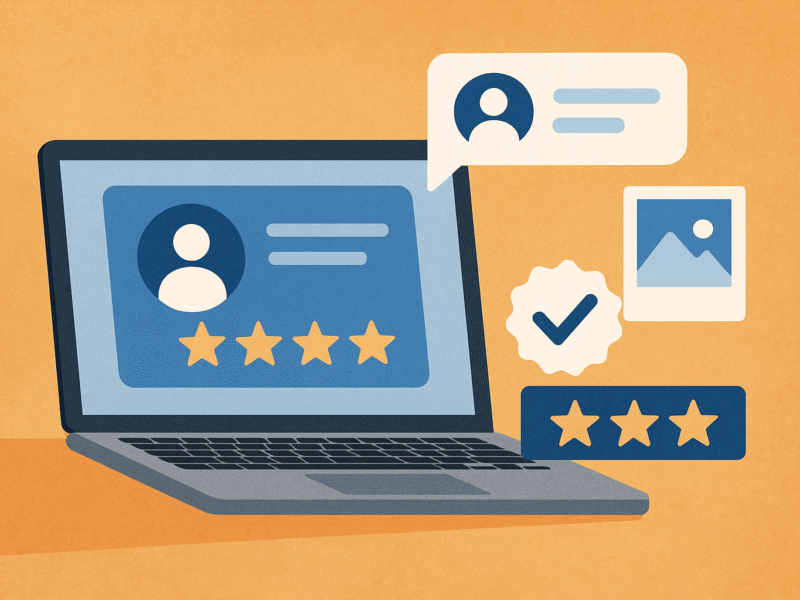
The Ultimate Guide to Leveraging Social Proof to Build Trust and Credibility
In an era where digital noise competes for every second of consumer attention, standing out isn’t just about crafting a compelling offer—it’s about earning trust. Today’s consumers are savvier than ever, with 93% saying online reviews influenced their buying decisions, according to a BrightLocal study. With countless ads flooding their social feeds, inboxes, and search results, modern buyers are constantly filtering out brands they don’t trust.
This is where social proof stakes its claim—not as a gimmick, but as a strategic trust ladder.
Used correctly, social proof becomes the marketing engine that moves potential customers from “maybe” to “yes.” It’s not only the spark that initiates interest, but also the confirmation that reassures prospects during final conversions. In fact, research from Spiegel Research Center shows that displaying reviews can increase conversion rates by up to 270%.
In this guide, we’ll show you how high-performing businesses use social proof—especially at the bottom of the funnel (BOFU)—to reduce buying friction, demonstrate authenticity, and drive measurable revenue results. Whether you run a SaaS startup, an eCommerce store, or a service-based agency, learning to apply the principles of social validation can be the ultimate differentiator in a crowded market.
Let’s dive into how to precisely leverage this powerful psychological trigger.
What Is Social Proof (And Why It Matters)?
Social proof is rooted in behavioral science and described extensively in Robert Cialdini’s book Influence: The Psychology of Persuasion. It refers to our innate tendency to imitate the actions of others in uncertain situations. In marketing terms? If your potential customer sees peers, experts, celebrities, or the crowd endorsing your brand, they’re more likely to follow suit.
But here’s the nuance: not all social proof is impactful.
Superficial vanity metrics like inflated follower counts or vague five-star ratings carry less weight today as consumers become more discerning. Instead, what works is credible social proof—stories, stats, and signals that resonate emotionally and logically. Real people, real results.
Strategic social proof builds psychological safety. It helps your audience answer the unspoken question: “Can I really trust this business to deliver what they promise?” When leveraged correctly—especially at critical decision moments—it removes doubt and establishes authority.
Here’s why that matters now more than ever:
- The average consumer reads 10 reviews before feeling they can trust a local business (BrightLocal).
- 70% of consumers look at product reviews before making a final purchase (PowerReviews).
- Websites using social proof experience a 15% higher conversion rate compared to those that don’t (Trustpulse).
When your buyers are close to conversion—whether that’s filling out a form, entering their credit card info, or booking a call—social proof plays a pivotal role in breaking down resistance and catalyzing action.
The 6 Types of Social Proof That Convert
Not all social proof is created equal. A single badge or bland testimonial won’t work magic alone. The potency lies in context: the right type of proof at the right moment in your buyer’s journey.
Let’s explore the six most compelling social proof formats and how they ladder into deeper trust:
- Customer Testimonials – These are short-form soundbites or videos from satisfied users that demonstrate satisfaction. They’re highly effective because they allow prospects to relate to real people facing similar challenges.
- Case Studies – More detailed than testimonials, case studies narrate a full arc: a problem, your solution, and the resulting wins. They’re exceptionally potent in B2B and high-ticket purchases where proof and due diligence are paramount.
- User-Generated Content (UGC) – Organic content created by users (e.g., Instagram posts, stories, tweets, review pictures) showcasing your product or service in action. This builds massive authenticity.
- Influencer or Expert Endorsements – Getting validation from niche influencers or well-known figures lends credibility fast. Think of these as authority transfers—borrowed trust from trusted sources.
- Trust Badges and Certifications – These are third-party validations like “VeriSign Secured,” Better Business Bureau ratings, or awards from respected institutions. These remove security concerns and instill buyer confidence.
- Social Numbers – These include total downloads, the number of users, or how many people recently bought a product. Social proof via scarcity and popular opinion fuels FOMO (fear of missing out).
✅ Quick Strategy Snapshot:
- Testimonials and case studies shine at the bottom of the funnel (BOFU), where detailed reassurance is needed.
- UGC and influencer endorsements tend to work best at the top and middle of the funnel (TOFU & MOFU), sparking first attention and ongoing nurturing.
- Trust badges & live notifications are perfect for checkout pages and conversion triggers.
By mapping these tools to buyer intent, you’re not just showcasing validation—you’re eliminating hesitation.
1. Using Testimonials Effectively: Turning Happy Customers into Your Best Salespeople
Think of testimonials as mini-commercials powered by your customers. These aren’t just compliments—they’re trust accelerators. A report by BigCommerce revealed that websites with fresh testimonials experienced up to a 35% lift in click-through rates (CTR).
But randomly sprinkling quotes across your website won’t move the needle.
What Makes a Testimonial Trustworthy?
Real impact lies in specificity and relatability. A vague “Amazing service!” doesn’t hold the same weight as:
“Within 90 days of implementing [Company]’s onboarding automation, our churn rate dropped by 27%, and customer satisfaction scores jumped to 8.9 out of 10.”
— Samantha Lee, Growth Manager, FinPay Solutions
When the testimonial speaks directly to your buyer’s pain point, it acts like a mirror. Your leads see themselves in the success story—and start to believe your solution can work for them.
Tips to Make Testimonials Convert:
- Use testimonials to neutralize objections. If one challenge frequently blocks your sales (e.g., startup integration time, ROI proof), showcase a testimonial tackling that exact fear.
- Integrate testimonials near CTAs, like pricing pages, demo request buttons, or proposal links. This artificial alignment nudges hesitant users forward.
- Don’t forget visual elements. Add profile images, company logos, or even LinkedIn icons to reassure readers it came from a real person.
Leveraging Video Testimonials for an Extra Edge
Video builds trust faster than text. In fact, 83% of video marketers say video helps with lead generation, according to Wyzowl. Platforms like Vocal Video or TestimonialHero make it simple to collect quick-response videos right from your happy clients.
Pro Tip: Structure the video into three parts—
- What challenge were they facing?
- How did your product help?
- What were the results?
This format reflects a mini case study—super digestible and shareable.
2. Showcasing User-Generated Content: Harness the Voice of Your Tribe
UGC is more than social fluff—it’s emotional equity. It turns your customers into powerful brand advocates and builds a community around your product or mission.
Let’s contextualize that with numbers: A study by Stackla found that 79% of people say UGC highly impacts their purchasing decisions, compared to only 13% who say branded content is impactful.
Why does UGC wield this kind of influence? Because it demonstrates usage rather than just promotion. It creates authenticity in a world increasingly skeptical of advertisements.
Effective Ways to Collect UGC:
- Launch a UGC campaign via hashtags: Encourage users to share how they use your product, tagging your brand with a unique hashtag. Glossier, for example, famously built its multibillion-dollar brand by doing just this.
- Engage your email list: Send post-purchase emails asking for photos, videos, or testimonials. Make it easy with click-to-upload forms.
- Gamify the submission: Reward users whose content gets featured with credit, badges, or discounts. It builds habitual participation.
Where to Showcase It:
- Your homepage visuals: Replace stock photos with real customer images. Airbnb and Warby Parker mastered this in their early days.
- Product pages: Add a UGC feed so prospects can see your product in real-world use.
- Live social walls: Tools like Taggbox or Pixlee let you embed UGC galleries right onto your site.
The message UGC sends is simple: “People like you are already loving this.” That’s a convincer money can’t buy—and algorithms love to prioritize.
Part 2: Engineering Trust in Real-Time: Advanced Social Proof Strategies
Welcome back. In Part 1, we laid the foundation, exploring the core types of social proof and how to harness the raw power of testimonials and user-generated content. These are the essential building blocks of trust.
But to truly dominate at the bottom of the funnel, you need more than static proof. You need to engineer moments of decisive validation that meet your prospect at the exact moment of doubt. This is where strategy transforms into a real-time psychological nudge.
In this section, we’re moving beyond the basics. We’re diving into the dynamic tools, the subtle badges of authority, and the data-driven case studies that don’t just suggest popularity—they scream credibility and eliminate risk.
The Power of Real-Time Validation: Beyond Static Proof
Static testimonials are powerful, but they live in the past. What convinces a hesitant buyer right now is the undeniable proof that others are actively choosing your product at this very moment. This is where live social proof widgets come into play.
These tools create a powerful sense of urgency and community through live notifications that pop up on your site, showing actions like:
- “Sarah from Chicago just purchased the Premium SEO Toolkit”
- “A customer just booked a ‘Discovery Call’”
- “Someone from Austin, Texas just downloaded the whitepaper”
Why does this work so well? It taps into two powerful psychological principles:
- FOMO (Fear Of Missing Out): Seeing others act creates a primal urge to join the group and not be left behind.
- Bandwagon Effect: The perception that a product is popular validates its quality. We’re hardwired to follow the herd, especially when the decision feels risky.
A study by Nielsen found that 92% of people trust earned media, such as recommendations from peers, above all other forms of advertising. Live notifications are the ultimate embodiment of this—a constant, automated stream of peer recommendations.
Implementation Tip: Use a tool like TrustPulse or ProveSource to set these up. The key is specificity. “Someone bought something” is weak. “John D. just upgraded to the Annual Growth Plan” is powerful because it’s specific, credible, and relevant to the high-intent page the visitor is on.
Authority Badges: The Silent Guardians of Trust
While live notifications provide the spark, authority badges provide the bedrock. These are the trust signals that address the subconscious security concerns every buyer has, especially when entering payment information.
Think of these not as decorations, but as psychological shortcuts. They instantly answer critical questions: “Is this site secure?” “Will my data be safe?” “Is this a legitimate business?”
The most effective badges are from recognized third parties that vouch for your security, credibility, or quality. Their value isn’t in their design, but in the authority they borrow.
- Security Badges: Norton Secured, McAfee Secure, SSL seals (e.g., “Powered by Stripe”).
- Industry Certifications: “Google Premier Partner,” “Shopify Plus Certified,” “BBB Accredited A+” .
- Media Features: “As seen in Forbes, TechCrunch, The Wall Street Journal”.
- Awards: “Winner of the 2024 Cuspera Customer Choice Award”.
The Psychology Behind It: These badges work through what Cialdini calls “Authority.” We are conditioned to defer to experts and established institutions. A security badge from a name like Norton is an expert saying, “This site is safe.” A media feature is an institution saying, “This company is noteworthy.” This borrowed credibility short-circuits doubt.
Strategic Placement is Everything: Don’t bury these at the footer. Place them at critical trust junctions: on your checkout page next to the “Pay Now” button, on your pricing page near the “Start Free Trial” CTA, and on your contact form. Their job is to be the final, silent guardian that gives the user the confidence to click.
Case Studies: The Ultimate Proof for High-Stakes Decisions
For B2B, SaaS, and high-ticket e-commerce, testimonials are the appetizer, but case studies are the main course. They are the undeniable, in-depth proof that moves high-value prospects from “I’m interested” to “I’m convinced.”
A powerful case study isn’t a story; it’s a blueprint for success that your prospect can see themselves in. It moves beyond “I liked it” to “Here’s exactly how it worked, and here’s the ROI.”
Crafting a Case Study That Converts: A Data-Driven Framework
The most effective case studies follow a narrative arc backed by hard metrics. They are structured to answer every objection a savvy buyer might have.
- The Hero (And It’s Not You): Start with your customer and their world. Detail their specific challenge, the roadblocks they faced, and the measurable impact of the problem. Example: “Acme Corp was losing $15,000 monthly due to inefficient manual data entry and a 23% employee error rate.”
- The Quest for a Solution: Describe their evaluation process. Why did they choose you? This is where you subtly reinforce your unique value proposition and differentiators. *Example: “They needed a platform that integrated with Salesforce without a 6-month implementation timeline. Our API-first approach and dedicated launch team sealed the deal.”*
- The Implementation (The “How”): Briefly outline the rollout process. This alleviates fears about complexity and downtime. Example: “We migrated their entire customer database in under two weeks with zero disruption to their sales team.”
- The Resolution & Hard Results: This is the climax. Lead with the most impressive metrics. Quantify everything.
- Quantitative Metrics: “Increased conversion rates by 45%,” “Reduced operational costs by $8,200/month,” “Achieved 327% ROI within the first year.”
- Qualitative Benefits: “The team regained 10 hours a week for strategic initiatives,” “Customer satisfaction scores jumped to an all-time high.”
From Story to Strategy: Promoting Your Case Study
A case study trapped on a hidden “Testimonials” page is a wasted asset. Repurpose its power:
- Dedicated Landing Page: Create a SEO-optimized page for each major case study.
- Sales Enablement: Equip your sales team with PDF one-pagers and specific quotes to use in proposals and demos.
- Targeted Ads: Use quotes and stats from the case study in LinkedIn ads targeting companies in the same industry or of a similar size.
By weaving together real-time social proof, authoritative trust signals, and undeniable case studies, you create a trust ecosystem. This multi-layered approach surrounds your prospect with validation at every turn, systematically dismantling objections and building the confidence required to convert.
Part 3: Building Your Social Proof Engine: Systematizing Collection and Orchestrating Impact
You now have the playbook. You understand the psychology, the types of proof, and the advanced tools for real-time validation. But knowledge without action is merely potential. The final, and most critical, step is building a repeatable system to gather, manage, and relentlessly optimize your social proof.
High-performing companies don’t treat social proof as a one-off campaign. They treat it as a core business function—an engine that constantly fuels their marketing and sales efforts. In this section, we’ll blueprint that engine.
Building a System for Continuous Proof Generation
Waiting for praise to roll in organically is a losing strategy. You must be proactive, making it effortless for customers to share their success.
1. The Strategic Ask: Timing and Targeting are Everything
The worst time to ask for a testimonial is six months after a purchase. The best time is at the peak of the customer’s joy—the moment they achieve their first win using your product or service.
- For SaaS: Automate a request after a user hits a milestone (e.g., “See you’ve sent your 100th invoice! Mind sharing your experience?”).
- For E-commerce: Trigger a post-purchase email sequence 7-14 days after delivery, asking for a photo or review once the customer has had time to use the product.
- For Services: Immediately after a project concludes successfully and the final positive feedback is received, formally ask for a case study.
2. Remove All Friction
A vague “We’d love your feedback!” gets ignored. A specific, low-friction request gets results.
- Use dedicated tools: Platforms like Vidyard (for video), Senja, or Testimonial allow you to create custom forms, send direct links, and even schedule interviews for case studies, all from one dashboard.
- Offer multiple formats: Some people will write an email, others will record a quick video on their phone. Let them choose. Provide clear guidelines: “Answer these three questions…” to make it brain-dead simple.
- Incentivize wisely: A discount on a future purchase, entry into a lottery, or simple public recognition can dramatically increase participation rates.
The Art of Strategic Placement: Mapping Proof to the Journey
Throwing social proof everywhere is like shouting in a crowded room—it creates noise, not clarity. The master strategy is to map specific types of proof to specific intent levels in the buyer’s journey.
- Top of Funnel (Awareness): Here, the goal is to spark interest and build brand familiarity. User-Generated Content and Expert Endorsements are perfect. A visitor browsing your blog isn’t ready to buy, but seeing a feed of real people using your product makes it feel vibrant and trustworthy.
- Middle of Funnel (Consideration): The prospect is evaluating solutions and comparing you to competitors. This is where Case Studies and detailed Testimonials do the heavy lifting. Place them on product feature pages, solution pages, and in nurturing email sequences. They provide the logical “why” behind choosing you.
- Bottom of Funnel (Decision): This is the moment of truth. The prospect is on your pricing or checkout page. Here, you must eliminate final friction with Trust Badges (security), Live Pop Notifications (urgency), and hyper-specific Testimonials that counter last-second objections about price or implementation.
Think like a surgeon, not a painter. Be precise. A/B test placing a specific case study on a high-value landing page and measure the impact on time-on-page and conversion rate.
Testing and Iteration: The Data-Driven Path to Mastery
Your work isn’t done once the social proof is live. This is where you transition from good to great.
What to A/B Test:
- Specificity: Test a vague quote (“Great service!”) against a specific, metric-driven one (“Saved us 10 hours a week”).
- Source: Does a testimonial from a “VP of Marketing at a Fortune 500” convert better than one from a “Startup Founder” for your target audience?
- Format: Test a text testimonial against a video testimonial on a key product page. Is the higher production effort worth the lift?
- Placement: Test a trust badge above the fold on your checkout page versus right next to the “Pay Now” button. Microns can make a million-dollar difference.
Measure Business Outcomes, Not Vanity Metrics
Don’t just track how many testimonials you collect. Track how they impact the metrics that matter:
- Conversion Rate Lift on pages where proof is added.
- Reduction in Cart Abandonment Rate after adding security badges and live notifications.
- Increase in Average Order Value (AOV) when social proof is used to highlight premium plans.
- Shortened Sales Cycle for B2B, as case studies answer objections before the sales call.
By systematizing collection, orchestrating placement, and obsessing over data-driven optimization, you transform social proof from a tactical weapon into a strategic asset. It becomes the quiet, confident voice that guides your prospects home, building not just transactions, but unwavering trust and lasting credibility.
Discover more from The Digital Cauldron
Subscribe to get the latest posts sent to your email.